How to Conduct Background Checks on Prospective Truck Drivers
The key to a safe and compliant fleet is effective background checks. When you’re hiring truck drivers, proper employment screening protects your company from liability and also cultivates a sense of safety and professionalism on the road. This guide is about how to conduct background checks on prospective drivers — step by step, with the latest best practices and tools.
Why Rigorous Screening Matters
An individual driver with a poor driving history can directly lead to accidents, fines, and negative impact on your company’s reputation. According to the data, the average collision fee involving commercial vehicles is about $91,000. That amount does not cover the time loss or the increase in insurance premiums. However, by spending money on initial thorough checks, you will:
- Decrease the chances of accidents and lawsuits
- Be compliant with FMCSA and other federal/state laws
- Prevent cargo theft or at least protect your brand
- Draw in talent that values professionalism
For instance, Trucking Talent employs a method of connecting those checks together using both automation and human review for improved precision.
Define Your Screening Policy
Prior to setting the orders for reports, you need to set a clear policy with the following points:
- Mandatory checks that need completion by each candidate (e.g., MVR, criminal records, drug testing)
- Disqualifying threshold (e.g., DUI within past 5 years)
- Steps in the process, by including how and when each check will be run
- Roles and responsibilities (HR, safety manager, recruiters)
Having a written policy helps you ensure consistency and protects you from discrimination claims. It also gives the candidate knowledge of the process, making it more transparent.
Obtain Consent and Comply with FCRA
As per the Fair Credit Reporting Act (FCRA), you must:
- Provide the potential candidate with a separate disclosure form that explains that you will use a third-party consumer reporting agency.
- Get the candidate’s written consent — without this document, you can’t legally require criminal background or credit reports.
- If you deny action (like disqualification), you need to issue a pre-adverse notice and a copy of the report, then a final adverse notice after the decision is made.
This protection is for both the company and the candidate, so the employment screening will be compliant and ethical.
Verify Identity
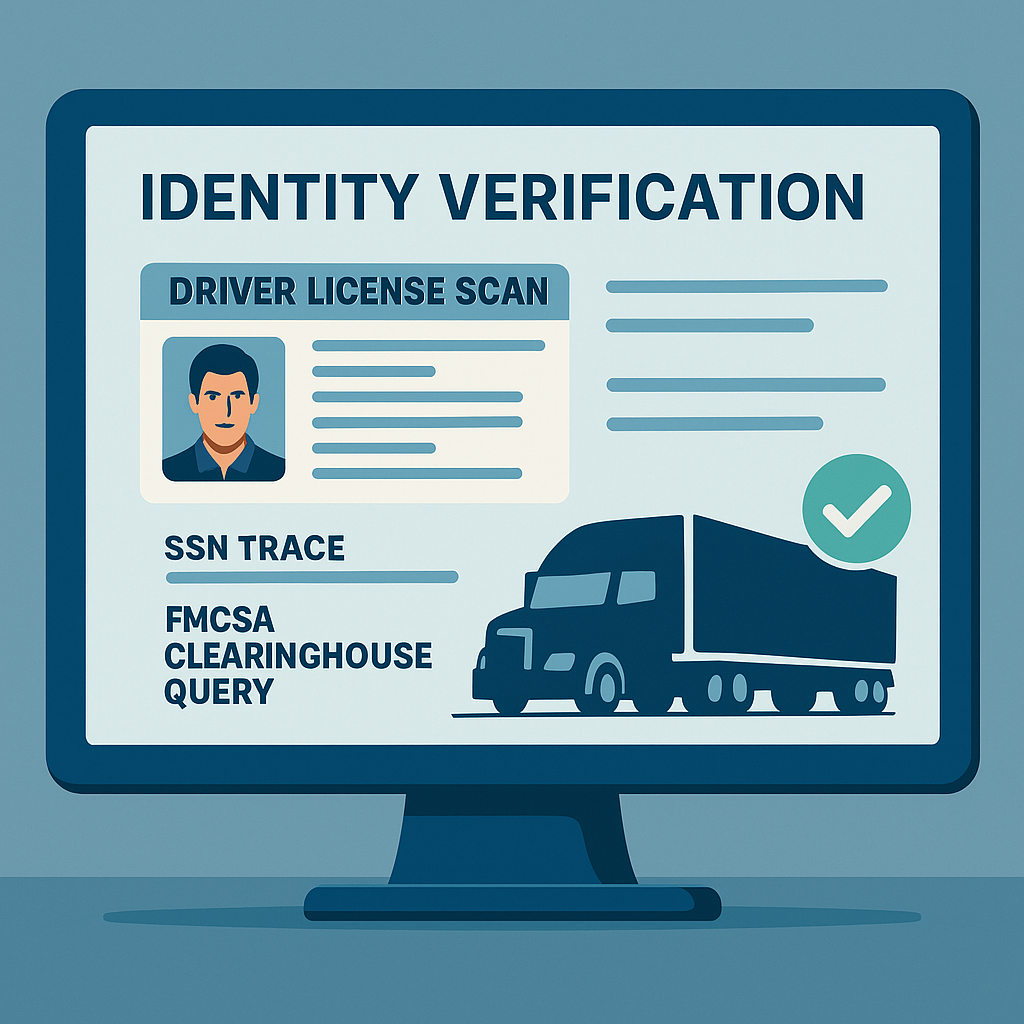
Identity fraud is not just an office issue — it can actually endanger lives on the road. Use an identity-verification service that checks:
- Driver’s license scans issued by the government (e.g., driver’s license, passport)
- Social Security Number (SSN) trace for address history
- Watchlist and sanctions screening (e.g., OFAC, terrorism)
Once convinced that the candidate is really who they allege to be, you no longer have to deal with “ghost” applicants and you will ensure that your records are in the name of the real person.
Review Motor Vehicle Records (MVR)

Driving history can be considered the most important check of all since your new hires are the ones to drive. An MVR report will reflect:
- Accidents and moving violations
- Current license status (suspensions, restrictions)
- License class endorsements (CDL-A, HAZMAT)
You may directly request these from most of the states or do so through an authorized vendor. It is crucial that you set forth the clear disqualifiers — for instance, “No more than two preventable accidents in the last three years.”
Query the FMCSA Clearinghouse
The FMCSA Clearinghouse is the national driver database for drug and alcohol violations. However, by the year 2025, all trucking companies are to:
- Perform a “full query” for every new driver before they can operate
- Conduct annual limited queries to check for any new entries
This registry includes DUI convictions, positive drug tests, and refusal to test. Since it is updated in real time, it is more trustworthy than state reports issued individually.
Conduct Criminal Background Checks
Criminal records can be researched at a few levels:
| Screening Type | Coverage | Typical Tools |
| County-level | Local misdemeanors/felonies | Vendor databases (e.g., Accurate Background) |
| Statewide | State convictions, warrant checks | State repository access |
| Multi-jurisdictional (MJIB) | Across multiple counties/states | National database vendors |
A good approach is to start with a multi-jurisdictional search that covers every county in which the candidate has lived or worked over the past seven years. Then, if there is something to raise the flag, go to the county courthouse records for verification. This stacked way is sufficient to be thorough and budget‑friendly.
Verify Employment and Education
While drivers do not always need a college degree, previous work history—especially with other carriers — matters a lot. The employment verification can reveal:
- Unreported terminations
- Gaps in work history
- Claims of supervisory or safety roles
Moreover, crosscheck any trucking-school certifications or HAZMAT endorsements through third-party verifiers. Some contemporary screening platforms are set up to directly link to training schools for automating this process.
Ensure Drug & Alcohol Compliance
In addition to the Clearinghouse query, also, the carriers must implement a sound drug and alcohol testing program:
- Drug test before employment (urine-based, 5-panel minimum)
- Post-accident tests when serious incidents occur
- Random testing program, at FMCSA-mandated rates
- Return-to-duty and follow-up testing protocols
Working with a trustworthy consortium or clinic network has the benefit of fast scheduling and reporting. The majority of carriers find it resourceful to the point of bringing mobile unit collection providers along to have drivers sampled at home or on the road.
Implement Continuous Monitoring
A one-off check does not guarantee safety for the future. Think about the following options:
- Continuous MVR monitoring: Automated alerts for new violations
- Social media scanning: Watch for red flags in public posts (e.g., showing unsafe driving)
- Drug & alcohol random pools: Keep drivers in the rotation each year
Implementing continuous monitoring will bring to light the issues that arise after hire, cautioning through all the time of employment.
Evaluate Results Fairly
When you are given reports, it is good to respect the following norms:
- Centralized review: Assign a compliance officer or safety manager to scrutinize findings
- Consider context: A single low-level offense may not disqualify a candidate, but repeated patterns should raise concern
- Document decisions: Take notes about why you decided to hire or not—this protects you from EEOC claims
- Communicate rapidly: Communicate in due time if adverse action has to be taken and include your company’s contact for disputes
Honest and clear evaluation is a good way of building trust and it is also a measure for reducing the legal risks.
Sample Background Check Workflow
| Step | Action | Owner | Timing |
| 1 | Send FCRA disclosure & obtain consent | HR | Upon offer |
| 2 | Run identity verification & SSN trace | Screening Vendor | Same day |
| 3 | Order MVR & FMCSA Clearinghouse query | Safety Team | Within 24 hours |
| 4 | Perform criminal background (MJIB) | Screening Vendor | 2 business days |
| 5 | Verify past employment & certifications | HR | 3–5 business days |
| 6 | Schedule pre-employment drug test | Safety Team | Prior to orientation |
| 7 | Review all reports & document findings | Compliance Officer | 1 business day |
| 8 | Communicate hire/reject decision with candidate | HR | Immediately after review |
This workflow is customizable to suit your fleet size and resources.
Building a Culture of Safety
The background checks screening that is too thorough will be about more than compliance — they will set a high standard. As soon as drivers perceive that your “care about safety” is perceptible, it is likely their behavior of following safety policies, reporting issues will be absolutely valid, and they will stay longer with your company. Companies like Trucking Talent combine screening with ongoing training programs, helping new hires understand that safety and compliance are not merely a list to check off — they’re part of the culture.
Next Steps
- Select the right vendor(s): The best screeners should have experience in the trucking industry, be easy to integrate with the FMCSA Clearinghouse, and have supportive customer service.
- Train your team: HR and safety managers should be instructed on how to read reports and the procedures that follow if they need to take adverse action.
- Automate where you can: Keep track of consent, run queries and issue notices using software.
- Review annually: Keep up-to-date with the policy you put in place by regulating changes e.g. new FMCSA rules.
- Communicate transparently: Let candidates know why each check is important — this builds trust and enhances the candidate experience.
If you abide by these steps, you will be able to find employees with background checks that not only protect your fleet but also save your wallet and most importantly keep everyone safe on the road — especially when partnering with Trucking Talent.