What Is a Load Board?
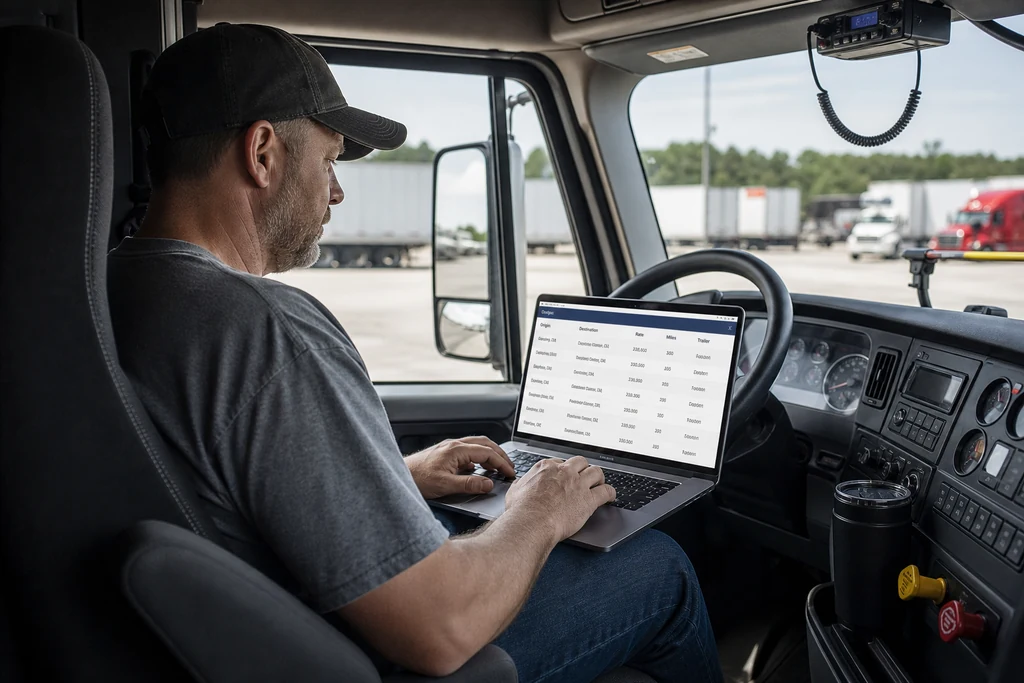
Finding freight is one of the most important parts of running a trucking business. A truck that is sitting empty is usually not generating revenue, so owner-operators and small carriers need a reliable way to find the next load after completing a delivery.
One of the most common tools for doing this is a load board.
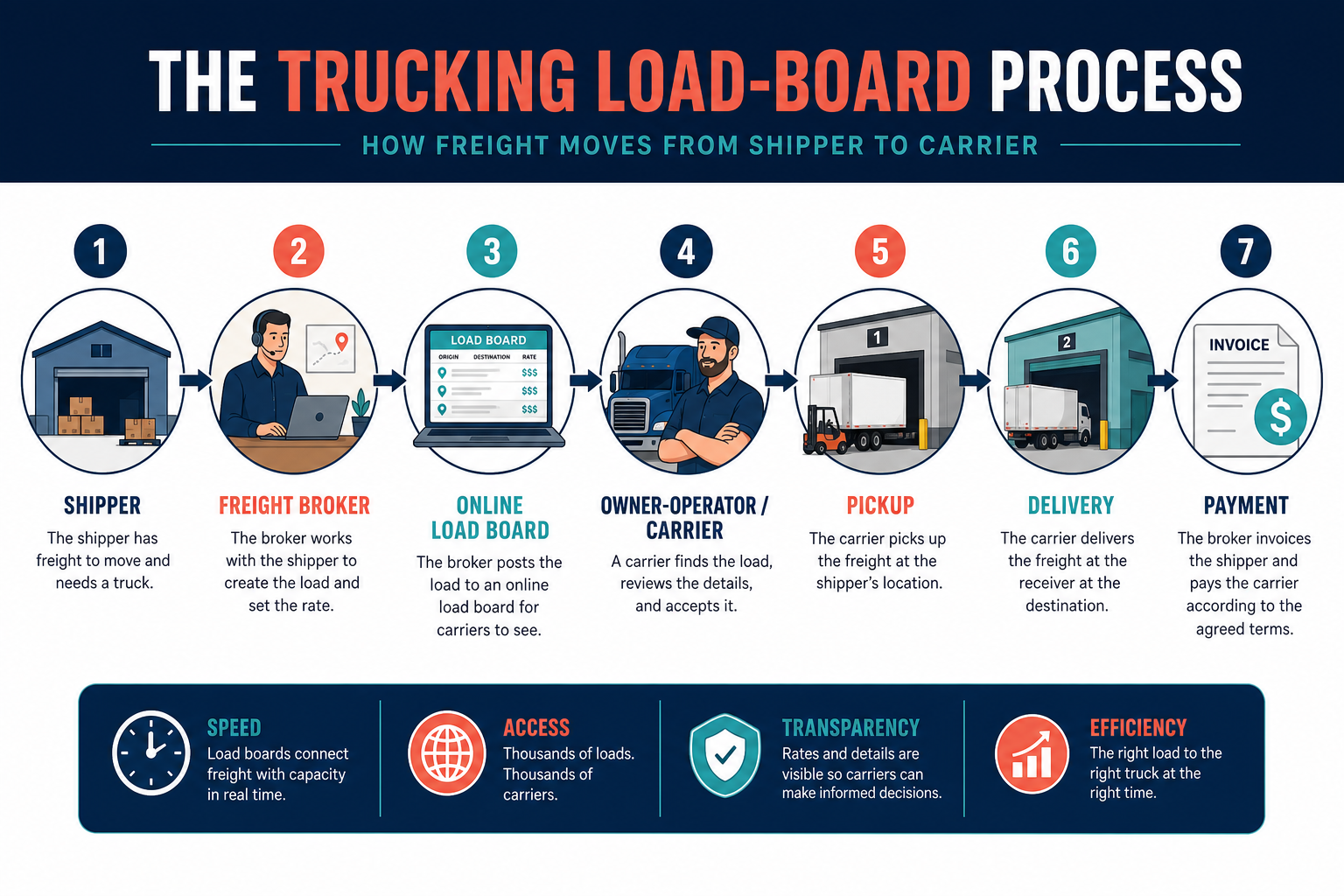
A load board is an online marketplace where available freight and available trucks can be posted. Freight brokers and shippers can list loads that need to be transported, while carriers, owner-operators, and dispatchers can search those listings and find freight that matches their equipment, location, schedule, and preferred destination.
In its simplest form, a load board works like a digital classified-ad system for trucking. A broker might post that a 40,000-pound dry-van load needs to move from Chicago, Illinois, to Dallas, Texas. An owner-operator with an empty dry van near Chicago can see the listing, review the details, contact the broker, negotiate a rate, and potentially book the load.
Modern load boards go far beyond simple listings. Depending on the platform and subscription level, they may also provide market-rate information, broker credit data, estimated deadhead, load alerts, route planning, truck posting, instant booking, payment information, and tools that help carriers decide whether a load is actually profitable.
Platforms such as DAT and Truckstop describe load boards as marketplaces where carriers can search for freight or post their available trucks, while brokers and shippers can post loads that need transportation.
For an owner-operator running under their own authority, understanding how to use a load board effectively can be just as important as knowing how to drive the truck.
How Does a Load Board Work?
The basic idea is straightforward.
Someone has freight that needs to move, and someone else has a truck available to move it.
The load board helps those two sides find each other.
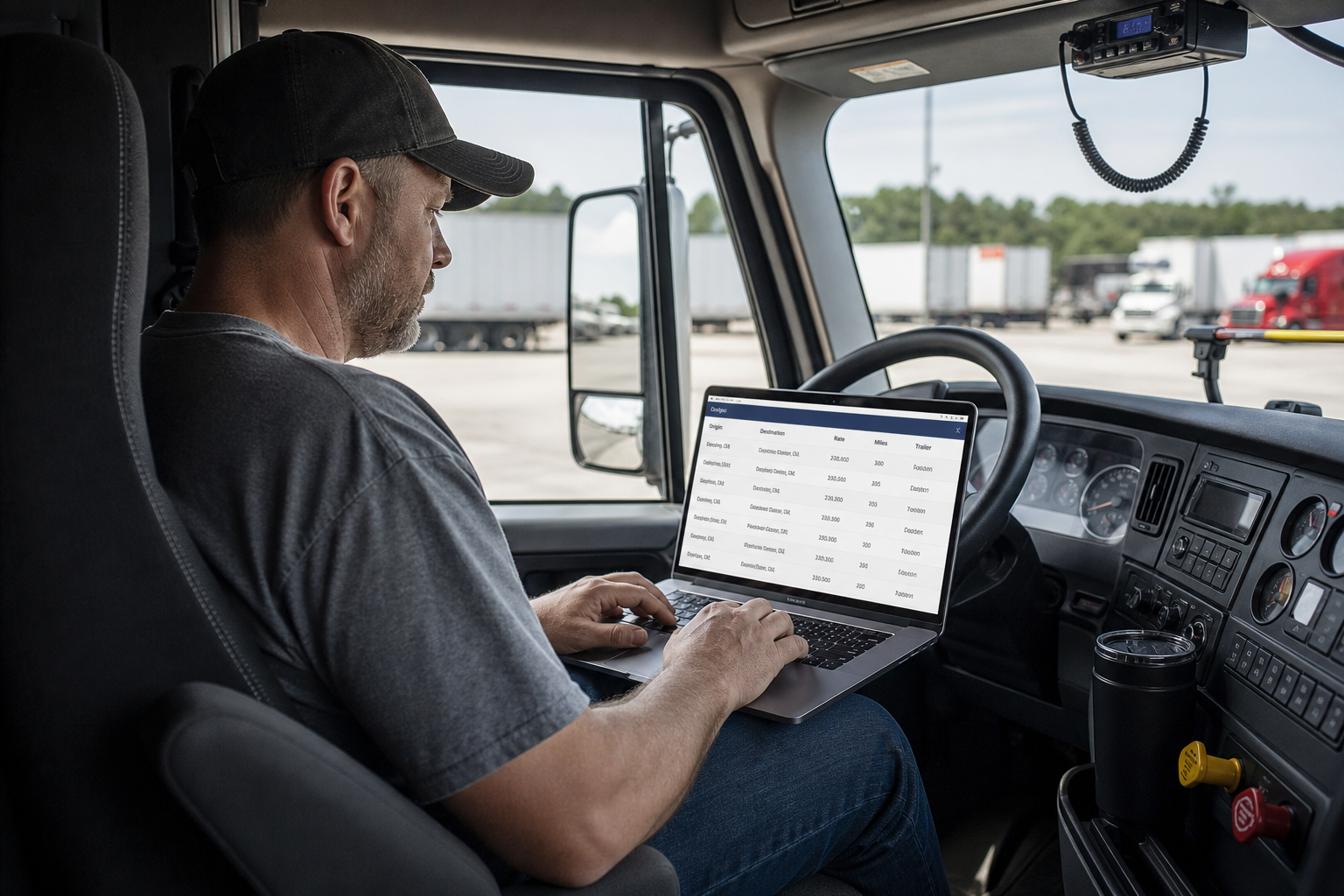
A freight broker or shipper creates a listing containing information about the shipment. The listing may include the pickup location, delivery location, pickup date, trailer type, weight, distance, commodity, rate, special requirements, and contact information.
A carrier then searches available freight using filters.
For example, an owner-operator who has just delivered in Atlanta may search for dry-van loads picking up within 50 miles of Atlanta and delivering somewhere near Nashville.
The load board might return dozens of options.
The driver or dispatcher can then compare them based on rate, destination, loaded miles, deadhead, broker reputation, appointment times, cargo weight, and other factors.
Once the carrier finds an attractive load, there are usually two basic possibilities.
The first is traditional negotiation. The carrier contacts the broker and asks whether the load is still available. The broker confirms the details and gives a rate. The carrier may accept the rate or negotiate.
The second is some form of digital or instant booking. Certain modern load-board listings allow qualified carriers to accept a load directly through the platform without a lengthy phone negotiation.
After the carrier and broker agree, the carrier typically receives a rate confirmation containing the agreed terms of the shipment.
The truck then picks up the freight, delivers it, obtains the necessary proof of delivery, and sends the required paperwork for payment.
The load board's main job is therefore to connect capacity with freight. It does not normally drive the truck, provide the carrier's operating authority, or automatically guarantee that every load is profitable.
Who Uses Load Boards?
Load boards are used by several parts of the trucking industry, and understanding their roles makes the entire process easier to understand.
Owner-Operators and Motor Carriers
Owner-operators and trucking companies use load boards primarily to find freight.
An owner-operator who has their own operating authority may search for loads after completing a delivery or may plan several loads ahead to build a complete week of freight.
Small fleets can use the same process across multiple trucks.
Instead of searching only for one load, a dispatcher may be trying to position five, ten, or more trucks throughout the country.
FMCSA defines a motor carrier as an entity that operates commercial motor vehicles to transport property, passengers, or hazardous materials in commerce. That can include both large fleets and individual owner-operators.
Freight Brokers
Freight brokers frequently use load boards because they have shipments that need carriers.
A broker does not normally provide the truck transporting the freight. Instead, the broker arranges transportation between the shipper and an authorized motor carrier.
FMCSA describes a broker as the middle party between a shipper and motor carrier that arranges transportation rather than physically transporting the property.
A broker may receive a load from a shipper, post it on a load board, speak with interested carriers, negotiate the transportation rate, and select a carrier to complete the shipment.
Shippers
Some load boards also allow direct freight from shippers.
A shipper may be a manufacturer, distributor, warehouse, retailer, food company, or another business that needs freight moved.
Direct shipper freight can be attractive to carriers because there may be an opportunity to develop a direct relationship instead of handling every load through a broker.
However, brokers remain extremely common on public load boards because many shippers prefer to outsource carrier sourcing and transportation management.
Dispatchers
Dispatchers may search load boards on behalf of carriers.
A dispatcher might monitor freight throughout the day, contact brokers, negotiate rates, plan routes, handle paperwork, and help keep the carrier's truck loaded.
The important distinction is that the truck still operates under the motor carrier's authority. DAT, for example, describes a model in which a carrier with the required authority can provide an account seat to a dispatcher who searches for loads on the carrier's behalf.
What Information Is Shown on a Load Board?
A good freight listing gives a carrier enough information to decide whether the shipment deserves further investigation.
The most important information normally begins with origin and destination.
You need to know where the truck has to pick up and where it will finish. Depending on the platform, the exact facility may not be visible until the load is booked, but the city or general area is normally shown.
The listing usually includes a pickup date and sometimes specific appointment information. This matters because a great-paying load is useless if your truck cannot legally or physically reach the shipper before the appointment.
Equipment type is another critical field.
A listing may request:
- Van
- Reefer
- Flatbed
- Step deck
- Power only
- Tanker
- Box truck
- Hotshot
- Specialized equipment
A carrier should not contact a broker about a 48,000-pound reefer load when operating an ordinary dry van.
Weight and commodity information also matter because they affect fuel consumption, vehicle handling, insurance requirements, cargo securement, and whether your tractor-trailer can legally carry the shipment.
Then there is the rate.
Some postings display the offered rate immediately. Others say call for rate, make offer, or provide a bidding system.
Modern load boards may also display additional business information such as broker credit scores, payment history, average days to pay, market-rate data, or historical lane information. DAT specifically advertises broker credit information, days-to-pay data, and lane-rate tools for carriers evaluating freight.
All of this helps answer the real question:
Is this load worth putting on my truck?
Understanding Rate Per Mile
One of the first numbers owner-operators learn to calculate is rate per mile, often abbreviated RPM.
The basic formula is:
Load revenue ÷ miles = rate per mile
Suppose a broker offers $2,400 for a load traveling 1,000 loaded miles.
The loaded rate is:
$2,400 ÷ 1,000 = $2.40 per loaded mile
That sounds fairly straightforward.
But there is a problem.
Your truck may not currently be sitting at the shipper.
Suppose you need to drive 100 empty miles before picking up the load.
Your truck actually travels:
100 deadhead miles + 1,000 loaded miles = 1,100 total miles
Now calculate the rate using all miles:
$2,400 ÷ 1,100 = about $2.18 per total mile
That is a much more useful number.
A load can look excellent when evaluated only on loaded miles and become much less attractive once deadhead is included.
Professional owner-operators therefore need to calculate the economics based on the truck's actual movement, not simply the mileage printed on the rate confirmation.
What Is Deadhead?
Deadhead means driving the truck without revenue-producing freight.
If your truck delivers in Memphis and the next load picks up 120 miles away in Nashville, those 120 miles are deadhead.
The truck is still consuming:
- Diesel
- Driver time
- Tires
- Maintenance
- Depreciation
- Available Hours of Service
But there is no freight revenue associated with those miles.
This is why minimizing deadhead is one of the biggest benefits of using a load board effectively.
A $3.00-per-mile load that requires 250 miles of deadhead may actually be less profitable than a $2.50-per-mile load picking up five miles from where you just unloaded.
The same concept applies at the delivery end.
A load going into a weak freight market may pay well going in but leave the truck with few good outbound options.
That means the carrier may need to deadhead hundreds of miles to find the next shipment or accept a cheap load simply to get out of the area.
Experienced carriers therefore evaluate both the current load and what is likely to happen after delivery.
Why the Highest-Paying Load Is Not Always the Best Load
New owner-operators often sort the load board by the largest total dollar amount.
That can be misleading.
Imagine two loads.
Load A:
Chicago to Dallas
$2,500
950 loaded miles
25 miles deadhead
Load B:
Chicago to Miami
$3,400
1,380 loaded miles
35 miles deadhead
Load B pays more total money.
But that does not automatically make it the better business decision.
The carrier also needs to consider fuel consumption, tolls, delivery appointment, weather, traffic, expected reload availability in Florida, and how much the next outbound load is likely to pay.
If the truck enters a market where there are far more available trucks than loads, negotiating power can shift toward brokers and shippers.
The truck may earn excellent money getting there and then struggle to leave profitably.
This is why some advanced load boards show inbound and outbound freight volume or other market-demand information. DAT, for example, markets tools showing load volumes and lane information intended to help carriers identify markets with different levels of truck demand.
Smart load selection is about the entire trip, not the biggest number on one posting.
What Is the Spot Freight Market?
Load boards are closely associated with the spot market.
Spot freight generally refers to transportation arranged for an individual load or short-term need at a rate reflecting current market conditions rather than a long-term contracted rate.
Suppose a manufacturer suddenly needs ten additional truckloads moved this week because production increased unexpectedly.
Its normal contracted carriers may not have enough available trucks.
The shipper or broker can move that additional freight into the spot market and search for available capacity.
Rates can move substantially depending on supply and demand.
When there are many loads and not enough available trucks, carriers may have greater negotiating leverage.
When there are many empty trucks competing for relatively few loads, rates can fall.
This is one reason spot-market owner-operators pay close attention to regional freight conditions.
The same truck, equipment, and driver may earn very different rates on the same lane at different times of the year.
Spot Freight vs. Contract Freight
Not every trucking company depends heavily on load boards.
Larger carriers often have contract freight, where rates and transportation relationships have been negotiated with customers over longer periods.
A carrier might agree to haul a customer's freight on the same lanes throughout the year at contracted rates.
Contract freight can provide more predictable volume.
Spot freight provides more flexibility.
An owner-operator using load boards may decide today whether to travel to Texas, Georgia, Ohio, or Pennsylvania depending on available rates.
But that flexibility comes with uncertainty.
There is no guarantee that tomorrow's market will offer the same rates as today's.
Many trucking businesses therefore use a mixture of both.
A carrier may have several direct customers providing regular freight and use load boards when it needs to fill gaps, reposition equipment, find backhauls, or keep trucks working between contracted loads.
For many successful owner-operators, the long-term goal is not necessarily to stop using load boards completely. It is to avoid being entirely dependent on whatever happens to be posted that morning.
What Is a Backhaul?
A backhaul is freight that helps move a truck back toward its home market, regular freight area, or another desirable destination after completing the original outbound shipment.
For example, an owner-operator based in Ohio might haul a load from Columbus to Atlanta.
Instead of driving 550 miles back toward Ohio empty, the driver searches the load board for freight moving from Georgia toward Ohio, Kentucky, Indiana, Pennsylvania, or another useful market.
That return load becomes the backhaul.
A profitable trucking operation is often built around thinking several steps ahead.
Do not simply ask:
What is the best load leaving here?
Also ask:
Where will this load put my truck, and what can I haul next?
Some load-board platforms specifically include backhaul or multi-trip search features designed to help carriers plan beyond a single shipment. Trucker Path's current TruckLoads platform, for example, includes backhaul searching and load alerts among its available tools.
Load Board vs. Freight Broker
These two terms are sometimes confused.
A load board is the marketplace or technology platform.
A freight broker is a business that arranges transportation.
Think of it this way:
The broker has a load.
The load board is one place where the broker advertises that load.
The carrier finds the advertisement and contacts the broker.
FMCSA requires property brokers operating under federal broker authority to meet registration requirements, including maintaining a $75,000 surety bond or trust fund arrangement.
The load board itself is not automatically the broker for every load listed on its platform.
This distinction becomes especially important when there is a payment problem or disagreement. The carrier's transportation agreement and rate confirmation are generally with the broker or shipper that booked the carrier, not merely with the website where the load was discovered.
Load Board vs. Dispatcher
A load board is also not the same thing as a dispatcher.
The load board provides access to freight information.
A dispatcher is a person or service that may use that information to manage freight for a carrier.
An owner-operator can operate without an independent dispatcher and personally search load boards, call brokers, negotiate rates, book loads, plan routes, and handle paperwork.
Another owner-operator may prefer to pay a dispatcher to perform much of that work.
The dispatcher might spend the day monitoring several load boards and speaking with brokers while the driver focuses on operating the truck.
Whether a dispatcher is worth the cost depends on the carrier, the agreement, the quality of the dispatcher, and how much administrative work the owner wants to handle personally.
But the important point is:
The load board is the tool. The dispatcher is the person using the tool.
Do Company Drivers Use Load Boards?
Most ordinary company drivers do not need to search public load boards for their own freight.
A company driver operates a truck for a motor carrier, and the carrier's dispatch department normally decides what loads the driver will haul.
The driver may finish one delivery and receive the next assignment automatically through the company's ELD, tablet, or dispatch system.
The driver does not normally negotiate directly with freight brokers or decide what rate the carrier receives.
Owner-operators operating under their own authority have a very different responsibility.
They are not only driving the truck.
They are also running the transportation business.
That means someone needs to find freight, negotiate rates, check brokers, send paperwork, invoice customers, manage expenses, and decide whether each load actually makes financial sense.
This is why load boards are discussed so frequently in owner-operator trucking.
Free Load Boards vs. Paid Load Boards
Some load boards offer free access, while others charge monthly subscription fees.
A free load board can be useful for a new carrier or someone who only occasionally needs spot freight. Trucker Path, for example, currently offers access to a free tier of its TruckLoads service while also offering paid features and subscription options.
Paid load boards typically justify their cost through additional freight volume or business tools.
Depending on the platform, those features may include:
- More load listings
- Rate history
- Broker credit information
- Days-to-pay information
- Load alerts
- Market-demand data
- Truck posting
- Multi-trip planning
- Instant booking
- Advanced search filters
The correct question is not simply:
"Why would I pay for loads when free load boards exist?"
The better question is:
"Does this service help my truck earn more than the subscription costs?"
If a $100 monthly subscription helps an owner-operator find one significantly better load, reduce deadhead, or avoid one broker with serious payment problems, the service may easily pay for itself.
On the other hand, there is no reason to subscribe to several expensive platforms that you rarely use.
Popular Load Boards for Truckers
There are many freight platforms in the United States, but several names appear frequently among owner-operators and small carriers.
DAT
DAT operates one of the largest commercial freight marketplaces and provides load searching, truck posting, market-rate information, broker data, and other carrier tools. DAT describes its platform as allowing carriers to search freight while also posting available trucks so brokers can find capacity.
Truckstop
Truckstop is another long-established freight marketplace. Its load-board tools allow carriers to search for freight or post available trucks, while brokers and shippers can post available loads. Truckstop also offers rate and broker-related tools depending on the service level.
Trucker Path TruckLoads
Trucker Path's TruckLoads platform provides load searching through web and mobile interfaces, along with features including load alerts, backhaul searches, rate information, and broker information depending on the plan.
These are examples rather than a universal ranking.
The best platform for one owner-operator may not be the best for another. Freight availability can differ by region, trailer type, broker network, and the carrier's normal lanes.
How Do You Book a Load From a Load Board?
Suppose you are an owner-operator with an empty dry van in Indianapolis.
You search for loads picking up within 75 miles.
A listing appears:
Pickup: Indianapolis, IN
Delivery: Atlanta, GA
Loaded miles: 535
Equipment: 53' Van
Weight: 34,000 lb
Pickup: Today
Delivery: Tomorrow morning
Rate: $1,550
Do not immediately click or call simply because the rate looks acceptable.
First, determine your deadhead.
If you are 15 miles from pickup, your total expected mileage is approximately 550 miles.
Then calculate:
$1,550 ÷ 550 = about $2.82 per total mile
Next, look at the broker.
Check available credit information, reviews, payment history, authority, and whether the contact information appears legitimate.
Then consider the appointments.
Can you reach pickup on time?
Can you legally deliver tomorrow morning within your Hours of Service?
Does the receiver take several hours to unload?
What does the freight market look like around Atlanta after delivery?
If everything still makes sense, contact the broker.
A typical conversation may cover the rate, commodity, weight, pickup and delivery times, loading requirements, whether the load is live or drop-and-hook, and any special conditions.
If the broker offers $1,550 and you believe the lane supports $1,750, you can negotiate.
Once an agreement is reached, the broker sends a rate confirmation.
Read it before accepting the load.
The rate confirmation should make the financial terms clear, including any detention, layover, TONU, lumper, tracking, or other conditions that may affect payment.
What Is a Rate Confirmation?
A rate confirmation, often called a rate con, is one of the most important documents in brokered trucking.
It normally confirms the agreement between the broker and carrier for the load.
The document may include:
- Carrier name
- Broker name
- Load number
- Pickup and delivery locations
- Appointment information
- Agreed transportation rate
- Commodity
- Weight
- Special instructions
- Detention terms
- Layover terms
- Tracking requirements
- Required paperwork
Do not look only at the dollar amount.
Some rate confirmations contain deductions or special requirements that can become expensive if ignored.
For example, a broker may require tracking to remain active during the shipment. Another may require paperwork to be submitted within a particular period. There may be instructions about seals, trailer cleanliness, detention notification, or delivery appointments.
Know what you are agreeing to before the truck arrives at the shipper.
What Happens After Delivery?
After the freight is delivered, the carrier normally receives documentation confirming delivery.
The most important document is often the signed Proof of Delivery, commonly called POD.
The carrier then sends the required documents to the broker or billing system.
Depending on the arrangement, the carrier may be paid directly according to the broker's normal payment terms.
Some carriers use quick pay, where the broker pays sooner in exchange for a fee.
Others use a factoring company.
With factoring, the carrier sells eligible invoices to the factoring company and receives most of the money sooner instead of waiting for the broker's normal payment cycle. The factoring company later collects payment from the customer.
This means finding a $3,000 load is only the beginning.
The trucking business does not actually benefit from that $3,000 until the freight is delivered properly and the carrier successfully collects payment.
Broker Credit Matters
One of the most useful features on some premium load boards is broker credit information.
A broker can offer an excellent rate, but an excellent rate is meaningless if collecting the money becomes a serious problem.
Depending on the platform, carriers may be able to view information such as average days to pay, credit score, carrier reviews, or other financial indicators.
DAT, for example, states that its carrier tools include broker credit scores, average payment time, and carrier reviews.
A new owner-operator should not choose freight based on rate alone.
Before accepting a load from an unfamiliar broker, investigate who you are dealing with.
A slightly lower rate from a reliable company that pays consistently may be a better business decision than chasing an unusually high rate from a company you cannot verify.
How to Verify a Freight Broker
Fraud is a real concern in the freight market, so verifying the company behind the listing is important.
FMCSA maintains public registration and authority information that carriers can use to check transportation businesses. The agency's fraud guidance recommends verifying phone numbers, emails, websites, authority information, and documentation rather than relying on a single source.
If someone claims to represent an established broker but contacts you from a completely unrelated email address or phone number, investigate before booking.
Compare the contact information with legitimate company information.
Check the MC and USDOT information.
Confirm that the company has the appropriate authority.
Be especially careful when communication suddenly changes during a shipment.
Scammers sometimes impersonate legitimate brokers or carriers using stolen company information, fake email addresses, altered rate confirmations, or fake websites.
FMCSA specifically warns carriers not to rely blindly on search-engine results because fraudulent profiles may appear in search results as well.
What Is Double Brokering?
One of the most serious fraud problems associated with freight marketplaces is double brokering.
A simplified example looks like this:
A legitimate broker gives a shipment to Carrier A.
Carrier A is supposed to transport the freight.
Instead, Carrier A secretly gives or sells the shipment to Carrier B without proper authorization.
Carrier B physically delivers the freight.
The original broker pays Carrier A because it believes Carrier A completed the shipment.
Carrier A disappears or refuses to pay Carrier B.
Carrier B performed the transportation but may never receive payment.
FMCSA has specifically discussed this type of unauthorized transfer when addressing broker and freight-forwarder financial responsibility and freight fraud.
There are multiple variations of the scheme, including identity theft and fake broker operations.
This is why carriers should verify counterparties rather than assuming that every listing on a load board is automatically safe.
Red Flags When Booking Loads
An unusually good rate deserves attention.
That does not automatically mean fraud. Brokers sometimes need trucks urgently and genuinely pay above-market rates.
But the further a deal moves away from normal market conditions, the more carefully it should be verified.
FMCSA's fraud guidance identifies several warning signs, including situations where someone asks a driver to identify themselves as a different carrier, gives suspicious instructions about a "blind" load, or quickly agrees to an unusually high rate.
Other warning signs can include sudden changes to pickup or delivery instructions, email domains that do not match the real company, pressure to act immediately without proper documentation, inconsistent phone numbers, or payment instructions that change unexpectedly.
If something does not make sense, stop and verify it.
Losing an hour investigating a suspicious load is much cheaper than hauling 1,500 miles and discovering that nobody intends to pay you.
Common Mistakes New Owner-Operators Make With Load Boards
One mistake is focusing exclusively on gross revenue.
A $4,000 load looks impressive until you calculate fuel, deadhead, tolls, maintenance, insurance, truck payment, trailer expense, factoring, and the poor reload market at the destination.
Another mistake is accepting freight before checking the appointment times.
A driver may find an excellent load but discover that the pickup is impossible to reach with the remaining Hours of Service.
New carriers also sometimes fail to negotiate.
The rate listed on the load board is not always the final rate. Depending on market conditions, the broker may have room to pay more.
The opposite mistake is refusing every load because the driver is waiting for a perfect rate that never appears.
A parked truck can also be expensive.
The goal is not winning every negotiation.
The goal is producing consistent profitable revenue over the week, month, and year.
Finally, do not book a load simply because you need something immediately.
Urgency makes people easier to scam and more likely to overlook bad business terms.
How to Use a Load Board More Effectively
The best load-board users usually develop a system rather than randomly searching the map.
Start by understanding your operating cost.
If you have no idea what your truck costs per mile, it is very difficult to know whether a freight rate is profitable.
Then learn your regular markets.
After operating for a while, you may notice that certain cities consistently provide strong outbound freight while others are difficult to leave.
Save searches for your most common lanes and use alerts when available.
Look at new freight early because attractive loads can disappear quickly.
Calculate deadhead before negotiating.
Research unfamiliar brokers before accepting freight.
And think at least one load ahead whenever possible.
For example, instead of booking Dallas → Miami simply because it pays well, look at Miami outbound freight first.
If the return market appears extremely weak, another destination may produce better weekly revenue even if its first load pays slightly less.
A load board becomes much more valuable when you stop viewing it as a list of isolated shipments and start viewing it as a map of where your business should position the truck.
Can You Run a Trucking Business Using Only Load Boards?
Yes, some owner-operators obtain most or even all of their freight through public load boards.
It is possible.
But depending entirely on public spot freight also means your business is highly exposed to market changes.
When spot rates are strong, this model can work extremely well.
When freight demand weakens, thousands of carriers may compete for fewer attractive loads.
That can pressure rates and make profitability much more difficult.
Direct customers and dedicated relationships can provide more stability.
Over time, an owner-operator may meet brokers through load boards and develop strong recurring relationships with them.
Eventually, those brokers may call the carrier directly when they have freight on familiar lanes.
That is one of the hidden benefits of load boards.
They are not only a way to find today's load.
They can also be a way to find tomorrow's customers and business relationships.
DAT itself describes its load board as a tool not just for searching listings but also for developing relationships with brokers and shippers.
Are Load Boards Worth It for New Owner-Operators?
For someone beginning operations under their own authority, a good load board can be extremely useful.
A new carrier probably does not yet have a large list of direct customers.
The truck still needs freight.
A load board provides immediate access to brokers and shipments throughout the country.
It can also help a new owner learn freight markets.
After searching every day, you begin seeing patterns.
You notice which cities have many loads.
You see how reefer rates differ from dry van.
You learn where deadhead becomes a major problem.
You discover which brokers repeatedly post freight on particular lanes.
And you begin understanding how rates change according to season, day of the week, location, equipment type, and truck availability.
That market knowledge can become extremely valuable.
The biggest danger is believing that access to thousands of listings automatically guarantees profit.
It does not.
A load board gives you opportunities.
Choosing the right ones remains the carrier's job.
Load Board FAQ
What Is a Load Board in Trucking?
A load board is an online freight marketplace where brokers and shippers can post loads and carriers or owner-operators can search for freight. Carriers can also post available trucks so brokers can contact them.
Who Uses Load Boards?
Owner-operators, motor carriers, freight brokers, shippers, and dispatchers all use load boards for different purposes.
Do Company Drivers Need Load Boards?
Usually not. A company driver's carrier normally assigns freight through its own dispatch system. Load boards are much more important to owner-operators and carriers responsible for finding their own freight.
Are Load Boards Free?
Some are free or offer limited free access, while many professional platforms charge subscription fees for additional freight and business tools.
What Are Some Popular Load Boards?
Examples include DAT, Truckstop, and Trucker Path TruckLoads. Available features, freight volumes, and pricing vary by platform.
What Does RPM Mean on a Load Board?
RPM normally means rate per mile. Drivers should calculate both the loaded rate per mile and the rate across all miles, including deadhead.
What Is Deadhead?
Deadhead is mileage driven without revenue-producing freight. High deadhead can make an apparently attractive load much less profitable.
Can You Negotiate Load Board Rates?
Often, yes. Some loads have fixed or instant-book rates, while others are negotiated between the carrier and broker.
What Is a Backhaul?
A backhaul is a load that helps move the truck back toward its home area, normal freight market, or another desired location after an outbound trip.
Are All Load Board Listings Safe?
No marketplace can eliminate every risk. Verify unfamiliar brokers and counterparties, check operating authority and contact information, review business data where available, and be alert to identity theft and double-brokering schemes. FMCSA publishes specific guidance on broker and carrier fraud.
Final Thoughts
A load board is one of the most important freight-finding tools available to owner-operators and small trucking companies.
It connects trucks that need freight with brokers and shippers that need transportation.
At a basic level, the process is simple: search for a load, review the route and equipment requirements, contact the broker, negotiate a rate, book the shipment, pick it up, deliver it, and submit the paperwork for payment.
But using a load board successfully requires much more than clicking on the highest rate.
A professional carrier needs to consider deadhead, total miles, fuel, weight, appointment times, Hours of Service, broker reliability, payment history, destination market, and the next available load.
The difference between a profitable load and a bad load is often hidden in those details.
For new owner-operators, load boards can provide access to freight before they have developed direct customers or long-term broker relationships. Over time, the same platforms can also help drivers understand freight markets and build relationships with companies that repeatedly need trucks.
Use load boards as a business tool rather than simply a list of available freight.
Know your operating costs.
Calculate the rate across all miles.
Research the broker.
Read the rate confirmation.
Think about where the truck will end up after delivery.
And remember that the goal is not simply to keep the trailer loaded.
The goal is to keep the truck loaded with freight that actually makes money.